
Why does CarPlay Ultra change the way infotainment needs to be tested?
 CarPlay Ultra changes the testing boundary
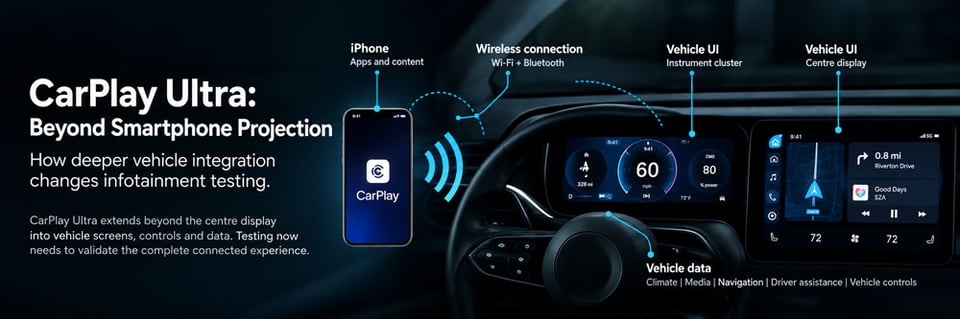
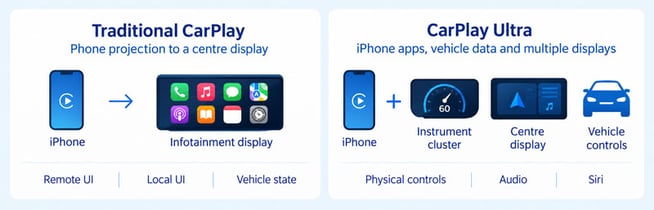
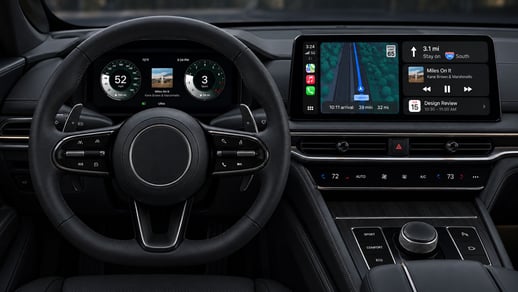
CarPlay Ultra moves beyond classic phone projection, combining iPhone powered content with vehicle information, multiple displays and real-time vehicle data. Testing must validate the same full end-to-end experience.
Why does deeper vehicle integration matter for testing?
CarPlay Ultra extends the experience from the centre display into the instrument cluster and deeper into the vehicle. Information and interaction can now move between iPhone-powered content, locally rendered vehicle interfaces, vehicle state and physical controls. The more systems involved, the more opportunities there are for timing, connectivity, state or integration issues to affect the customer experience. Testing therefore needs to follow the complete path through the phone, wireless connection and vehicle rather than treating each element in isolation.
Where does CarPlay Ultra become difficult to test?
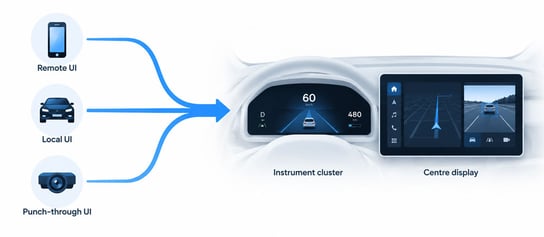 CarPlay Ultra introduces a different kind of integration problem. The experience can combine content rendered by the iPhone with gauges and vehicle information rendered locally, while functions such as cameras and driver-assistance displays can remain entirely under the control of the vehicle. These elements still have to appear as one coherent user experience. Apple synchronises the different rendering sources at frame level and relies on the vehicle to provide current state information throughout the session.
That creates failure modes that are easy to miss in conventional feature testing. The vehicle displays may wake before the iPhone reconnects. A physical control may change a vehicle setting while the corresponding CarPlay screen is already visible. Wireless connectivity may briefly degrade while locally rendered information remains active. A camera or ADAS view may have to interrupt iPhone-rendered content and then return the driver to the correct previous state.
The transition into and out of the rearview camera is one example of this wider testing challenge. Our article on rearview camera reliability explores how vehicle state, display timing and smartphone projection interact.
Testing needs to confirm how the individual functions work together throughout the driver’s journey.
For testing the important question is therefore not simply whether navigation, media, climate or the instrument cluster works. It is whether the complete system remains synchronised while vehicle state, user interaction and connectivity are changing at the same time.
What does iOS 27 add to the CarPlay test matrix?
 iOS 27 adds new media, voice and navigation behaviours on top of an already more integrated CarPlay environment. The important testing change is not simply that there are more features. Each new behaviour introduces additional combinations of phone state, application state, vehicle capability and user interaction.
Video is a good example. Playback may be available while the vehicle is parked but become unavailable when the vehicle state changes, requiring the experience to transition correctly to audio-only playback and subsequently recover. Voice interactions can overlay navigation or other content, while richer media and navigation states introduce more combinations of touchscreen, rotary, steering-wheel and physical control behaviour.
An iOS update can therefore change the behaviour of the in-vehicle experience even when the vehicle software itself has not changed. For OEM validation teams, that makes operating-system updates part of the ongoing regression matrix rather than simply a phone compatibility check.
What should a CarPlay Ultra test strategy cover?
 CarPlay Ultra validation has to cover more than individual functions. Connectivity, wireless performance, display behaviour, vehicle integration and user interaction all need to remain consistent as the system moves through different states. The important part is how these areas behave together: a phone reconnecting while displays wake, vehicle data changing while CarPlay is active, or a user moving between touch, physical controls and voice. Testing therefore needs to combine device coverage with repeated real-world journeys, so that faults caused by timing, state changes or interactions between systems can be exposed rather than missed in isolated feature tests.
See end-to-end testing in practice - Watch Nextgen automate infotainment user journeys, combining navigation, calls, media and smartphone projection.
Why do problems appear between the features?
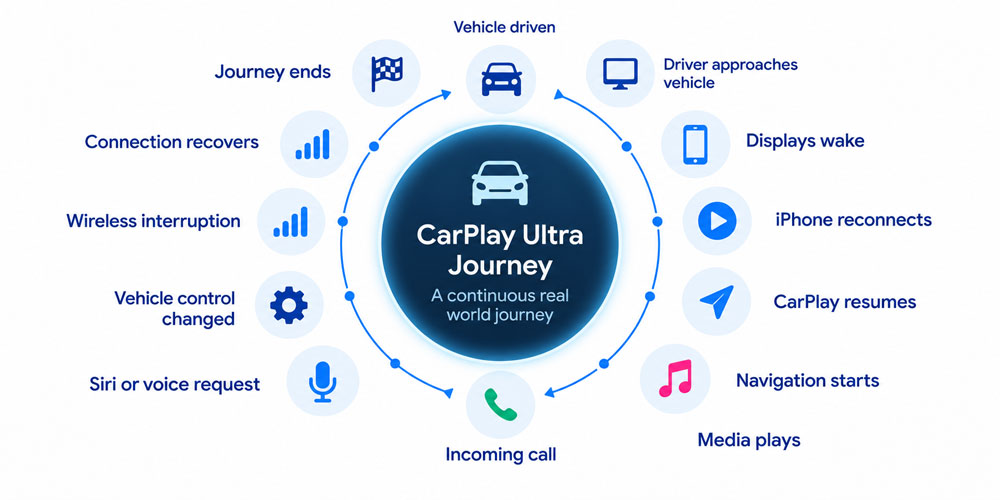
Drivers do not experience CarPlay Ultra as a collection of separate functions. They approach the vehicle, the displays wake, the phone reconnects, navigation starts, media plays, calls arrive, voice commands are made and vehicle controls are used. Each transition changes the state of several systems at once.
That is where difficult faults often appear, as a function may work correctly when tested alone but fail after a particular sequence of events ..or only when another service is active at the same time. Nextgen tests these connected journeys end-to-end so that the behaviour of the phone, wireless connection, displays, audio, vehicle data and controls can be assessed together. When an issue occurs the surrounding conditions can be captured rather than relying only on the final symptom.
A Real-World CarPlay Ultra User Journey
Why is one successful test run not enough?
Many connected infotainment problems are intermittent. The same journey can complete correctly dozens of times before a particular combination of phone activity, vehicle state, wireless conditions or timing exposes a failure. Manual testing alone makes these low-occurrence problems difficult to find and even harder to reproduce.
Nextgen uses automated stress testing to repeat real user journeys consistently across devices, software versions and operating conditions. Nextgen's ATAMConnect automation executes the journey repeatedly while capturing the evidence around any points of failure. This allows teams to move from simply knowing that something failed to understanding what the phone, vehicle and connected systems were doing when it happened. Automation can increase coverage, expose low-occurrence faults and provide the evidence needed for detailed investigation and regression testing.
How does Nextgen turn intermittent failures into engineering evidence?
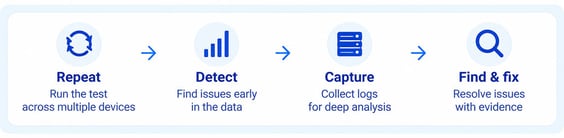 Nextgen combines infotainment interoperability expertise with automated end-to-end testing and detailed fault investigation. We can validate behaviour across iPhones, wireless connections, vehicle displays, vehicle data, media, navigation, voice and physical controls while capturing logs, video, audio, timing and test-state information when problems occur. The objective is not simply to find more failures. It is to make those failures repeatable, explainable and useful to the engineering teams responsible for fixing them.
Need to understand how CarPlay Ultra behaves on your vehicle platform?
 Talk to Nextgen about interoperability testing, automated stress testing and root-cause investigation for connected infotainment systems.
Talk to Nextgen about CarPlay Ultra interoperability, automated stress testing and root-cause investigation, contact Nextgen or call +44 3331 120 000 or let's set up an online meeting.
